For dealer-bought hardwood
Hardwood Board Foot Calculator
Hardwood is billed by actual size and rounded up to the nearest quarter (4/4–12/4), so your tally matches the dealer's invoice. New here? See how to calculate board feet.
How are hardwood board feet measured?
Hardwood lumber is graded and priced by the actual dimensions of the board — its real thickness, width, and length. That is the opposite of softwood 2×4s, which are priced by nominal size. Two rules from the National Hardwood Lumber Association (NHLA) drive the math:
- Thickness rounds up to the nearest quarter inch. A board planed to 0.9″ is still billed as 4/4 (1″). A rough 1.1″ board is billed as 5/4 (1.25″).
- Each board's board feet rounds to a whole number. Boards are tallied individually, not summed then rounded, which is why a long cut list can differ from a single calculation.
Quarter thickness chart (4/4 to 12/4)
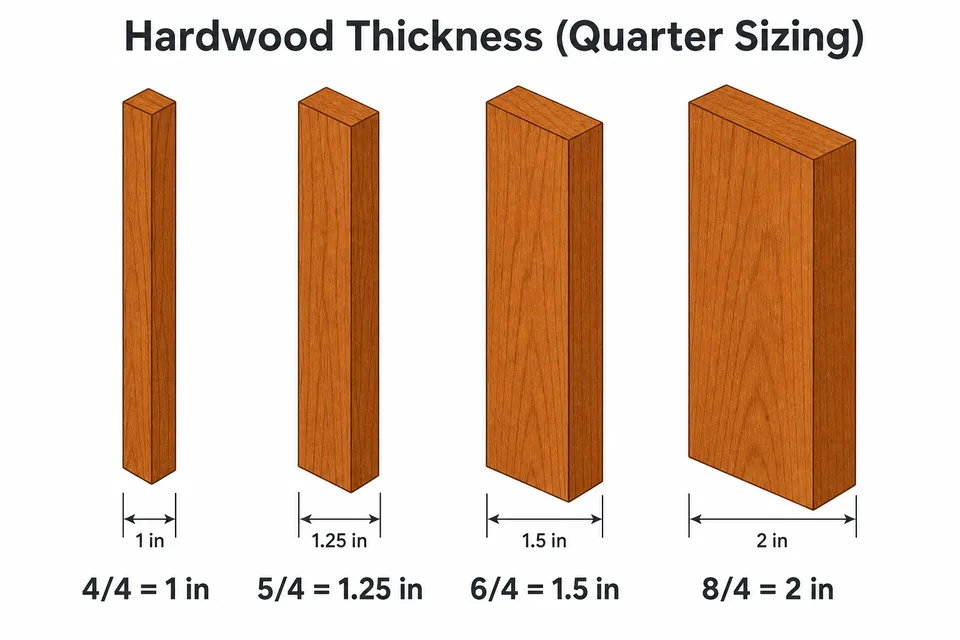
| Quarter | Inches |
|---|---|
| 4/4 | 1.00″ |
| 5/4 | 1.25″ |
| 6/4 | 1.50″ |
| 8/4 | 2.00″ |
| 10/4 | 2.50″ |
| 12/4 | 3.00″ |
Full detail on each size lives in the hardwood lumber thickness guide.
How does NHLA rounding change a board's tally?
Here's the kind of board I tally every week. Say you want a 6/4 walnut board, 7⅜″ wide and 8 ft long. Enter thickness 6/4 (the calculator reads it as 1.5″), width 7 3/8, and length 8. The net board feet are 1.5 × 7.375 × 8 ÷ 12 = 7.38 BF, billed as 7 BF after NHLA rounding to the nearest whole foot. Add a walnut price to see cost, and the result shows estimated weight from walnut's density (about 3.2 lb/BF).
Now stretch that board to 9⅝″ wide and the net jumps to 1.5 × 9.625 × 8 ÷ 12 = 9.63 BF, which rounds up to 10 BF. The rounding can swing either direction by board, but across a 200-piece pack it tends to land in the seller's favor — which is why I always run my own tally before signing.
Always verify a hardwood tally yourself before paying. NHLA allows a small tally variation, but the rounding direction should never consistently favor the seller. If it does, ask how thickness was measured. See how to buy lumber by board foot.
What does hardwood cost per square foot of face?
A board foot is one square foot of face an inch thick, so the price of a square foot of face is the price per board foot multiplied by the thickness you are billed for. That one identity answers the question hardwood buyers actually ask at the counter: what will this top, shelf, or door panel cost in each quarter call?
| Quarter call | Billed thickness | Cost per sq ft of face |
|---|---|---|
| 4/4 | 1.00″ | $10.00 |
| 5/4 | 1.25″ | $12.50 |
| 6/4 | 1.50″ | $15.00 |
| 8/4 | 2.00″ | $20.00 |
| 10/4 | 2.50″ | $25.00 |
| 12/4 | 3.00″ | $30.00 |
Put it on a real panel: a 3 ft × 6 ft desk top is 18 sq ft of face. In 4/4 that is 18 board feet and $180 at the example rate; 5/4 runs 22.5 board feet and $225; 6/4, 27 board feet and $270; 8/4, 36 board feet and $360. The face is identical in every line — only the billed thickness changes, and it doubles the bill between 4/4 and 8/4.
Read the table backwards when you have a budget per square foot instead of a price per board foot. At $15 per sq ft of face you can pay up to $15/BF for 4/4, $12/BF for 5/4, $10/BF for 6/4, and $7.50/BF for 8/4. Two quotes that look close per board foot can land far apart per square foot of finished panel, which is why thickness belongs in any hardwood price comparison.
One consequence of the surfacing allowance is worth carrying to the counter. A quarter call loses 3/16″ to 1/4″ in surfacing, a fixed amount rather than a percentage, so it is 18.75% of a 4/4 board's invoice thickness but 8.3% of a 12/4 board's. Divide the face cost by the usable thickness and the rate per usable inch is $12.31 in 4/4 and $10.91 in 12/4 at the example rate. Thick stock is not proportionally more expensive per usable inch — that is the arithmetic behind the usual advice to order one quarter thicker than the finished part.
Two boundaries keep the number honest: it prices one face only, so edge grain and the back are not in it, and it is lumber cost before trim and defects. Add the waste factor before you compare it with a finished top's price, and if your plan is drawn in square feet, convert board feet to square feet first.
Frequently asked questions
Is hardwood measured by nominal or actual size?
Hardwood is measured and priced by actual size, unlike softwood. Thickness is usually rounded up to the nearest quarter inch (4/4, 5/4, 6/4) and 4/4 — one inch — is the minimum a dealer will bill. A 1″ board is 1 BF; a 13/16″ S2S board still bills at the 4/4 call.
What does 4/4 mean in hardwood?
4/4 means four quarters of an inch, or one inch of rough thickness. 5/4 is 1.25 inches, 6/4 is 1.5 inches, and 8/4 is 2 inches. After surfacing the finished board is thinner — 4/4 lands near 13/16″, which is the shrinkage laid out in the hardwood thickness guide.
Why is my hardwood bill higher than my measurement?
Dealers round thickness up to the next quarter and round each board’s board feet to a whole number, and they may price by rough rather than surfaced measure. Those rounding rules add up across a tally — the arithmetic behind a real invoice is in gross vs net tally.
How much does hardwood cost per square foot?
Multiply the price per board foot by the billed thickness in inches. At $10 per board foot, 4/4 stock is $10 per square foot of face, 6/4 is $15, and 8/4 is $20. That is lumber cost on one face, before any waste allowance.