Lumber terms, defined
What Is a Board Foot?
A board foot is 144 cubic inches of lumber — the amount of wood in a board 12 inches wide, 12 inches long, and 1 inch thick. It is a unit of volume, which is exactly why it trips people up: it isn't the surface you see, it's the wood you're paying for. Once you've got the definition, calculating board feet is one short formula.
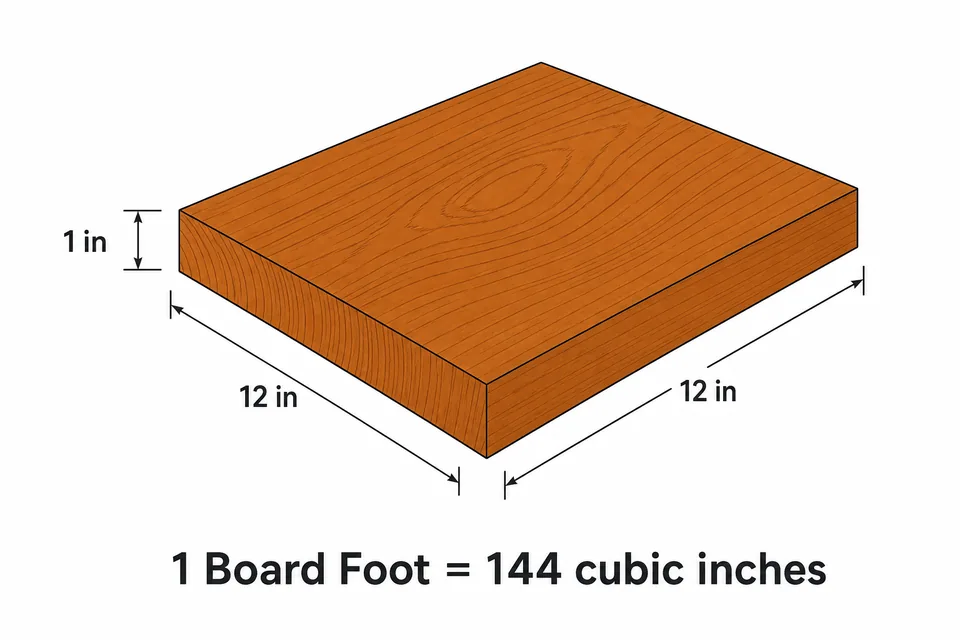
The first time I tallied a rack of rough walnut as a young buyer, I made the classic mistake — I counted the faces of the boards like square footage and landed on exactly half the dealer's number. The boards were 8/4, twice as thick as I'd assumed. That afternoon taught me what a board foot really is, and it's the one definition every lumber buyer has to get into their bones.
Here are the numbers behind that afternoon. The rack was 30 boards of 8/4 walnut, 10″ wide and 9′ long. Counting faces, I had 7.5 square feet a board and told myself 225 "units" of lumber. Counting volume, each board is 2 × 10 × 9 ÷ 12 = 15 BF, which makes the rack 450 board feet. At $13 a board foot that's a $5,850 bill against the $2,925 I'd mentally written. Twice the thickness, twice the wood, twice the price.
Why does a board foot measure volume, not area?
Two boards can cover the same wall yet contain very different amounts of wood, because one might be twice as thick. Pricing by area would let a buyer pay the same for half the material. Board feet fix that by counting volume, so a 2-inch-thick slab is correctly worth twice a 1-inch board of the same face size. That is the entire reason the unit exists.
Think of it as the wood's "weight class." A square foot tells you how much surface a board covers; a board foot tells you how much actual timber is there. When a dealer quotes "$13 a board foot," they're pricing the volume of material, not the footprint, which is the only fair way to compare a thin 4/4 plank against a chunky 8/4 turning blank.
How big is one board foot, physically?
A board foot is always 144 cubic inches, but the shape it takes depends entirely on how thick the stock is. Hold the width at a common 6″ and one single board foot stretches or shrinks like this:
| Thickness | Hardwood call | Face area in 1 BF | Length at 6″ wide |
|---|---|---|---|
| 0.50″ | 2/4 | 2.00 sq ft | 48″ (4 ft) |
| 0.75″ | 3/4 | 1.33 sq ft | 32″ |
| 1.00″ | 4/4 | 1.00 sq ft | 24″ |
| 1.50″ | 6/4 | 0.67 sq ft | 16″ |
| 2.00″ | 8/4 | 0.50 sq ft | 12″ |
| 2.50″ | 10/4 | 0.40 sq ft | 9.6″ |
Read the last two columns as a rule of thumb: double the thickness, halve the lumber you get from one board foot. That's the whole reason a stubby 8/4 turning blank can cost more than a long, thin board that covers four times the wall. Per-foot pricing by size lives in the board foot cheat sheet if you want the table for the yard.
Where did the board foot come from?
The board foot is an old American sawmill unit, built so a mill could price irregular hardwood by a single common measure. Hardwood doesn't come in tidy widths the way framing lumber does — a log yields random-width boards — so counting pieces or linear feet would be meaningless. Volume was the equalizer, and 144 cubic inches (a 1-inch board, one foot square) became the standard slug. More than a century later, the National Hardwood Lumber Association still grades and tallies by it, and that's why your hardwood invoice reads in board feet while the home center sells you studs by the piece.
Where will you see board feet used?
- Hardwood lumber — sold almost universally by the board foot because widths are random.
- Rough-sawn and live-edge stock — priced per board foot before milling.
- Sawmills and log scaling — estimated yield in board feet via log rules.
- Spray foam insulation — borrows the term for coverage, which is a different calculation.
Notice the pattern: board feet show up wherever the wood comes in irregular sizes and the price has to track the material, not the shape. Softwood framing escapes it because a 2×4 is always a 2×4 — predictable enough to sell by the stick.
How is a board foot different from other units?
Construction softwood is often counted in pieces or linear feet, and sheet goods in square feet. None of those tell you the volume of wood the way a board foot does. A linear foot ignores width and thickness; a square foot ignores thickness. Only the board foot captures all three dimensions, which is why it survives as the trade's pricing unit for solid lumber.
Here's the quick gut-check I use: if the question is "how much wood is in this," it's board feet. If it's "how long is this trim," it's linear feet. If it's "how much floor will this cover," it's square feet. To turn a real board into board feet, use the board foot formula or just the calculator.
Once you understand a board foot is volume, the yard's invoice stops being a mystery. You can see exactly why a thicker or wider board costs more, and you can check the math yourself. That's the difference between hoping the price is fair and knowing it.
Frequently asked questions
What is one board foot?
One board foot is 144 cubic inches of lumber — a board 12 inches wide, 12 inches long, and 1 inch thick. It is a measure of volume.
Is a board foot the same as a square foot?
No. A square foot measures area and ignores thickness; a board foot measures volume and includes it. A 1-inch board has the same board foot and square foot count, but a 2-inch board has twice the board feet. See board feet vs square feet.
Why is lumber sold in board feet?
Because price should reflect the amount of wood, and hardwood comes in random widths and thicknesses. Volume is the fairest common unit across odd-width boards.