Decode the quarters
Hardwood Lumber Thickness Guide
Hardwood thickness is written in quarter-inches: 4/4 = 1″ 5/4 = 1.25″ 6/4 = 1.5″ 8/4 = 2″, on up through 12/4 and 16/4. That number is the rough thickness before milling, and it's what you're billed on — so reading the quarters correctly is half the battle in getting your board foot count to match the dealer's.
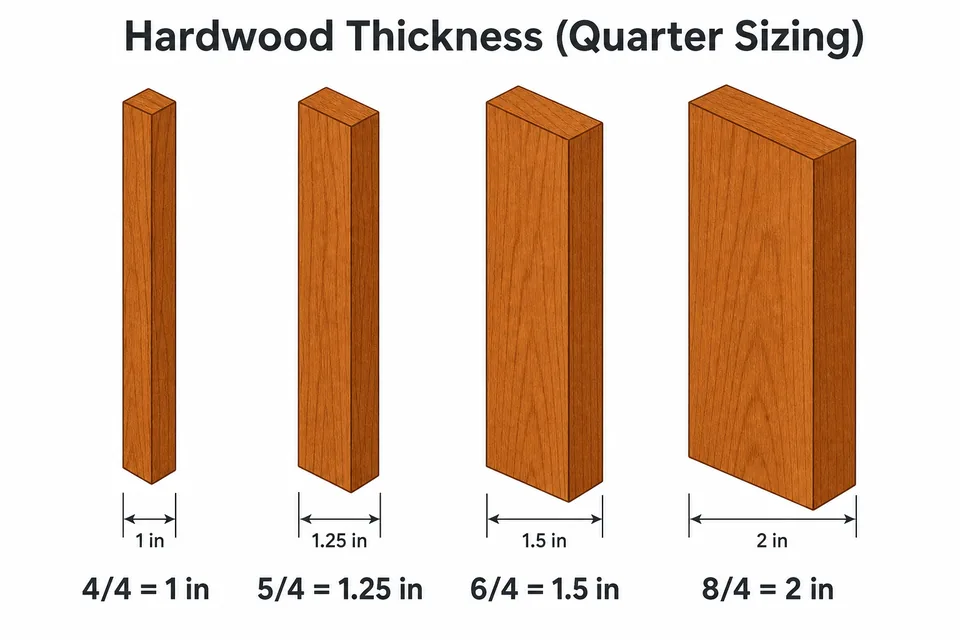
The first pack of "one-inch" cherry I ordered as a green buyer showed up measuring 13/16″ once it was surfaced, and I spent an afternoon certain the mill had shorted me. It hadn't. I'd confused the rough call with the finished board — and that exact mix-up is still the most common reason a woodworker calls me about thickness that "doesn't measure up." Once the quarter system clicks, it never trips you again.
What does the quarter system actually mean?
The denominator is always 4 because hardwood thickness is counted in quarter-inches of rough stock. So 4/4 is four quarters (1 inch), 6/4 is six quarters (1.5 inches), 8/4 is eight quarters (2 inches), and the pattern keeps climbing — 12/4 is 3 inches, 16/4 is a full 4 inches. The convention survives from the sawmill, where green boards are sawn to quarter-inch thickness increments and graded before anyone knows what they'll become.
You'll hear the calls spoken aloud, too: "four-quarter" for 4/4, "six-quarter" for 6/4, "eight-quarter" for 8/4. A dealer who says "I've got eight-quarter ash" means 2-inch rough stock. Width and length are still measured in plain inches and feet — only thickness gets the quarter treatment, because thickness is the dimension the mill controls most deliberately at the saw.
What's the difference between rough and surfaced thickness?
Rough thickness is the sawn-and-dried number the quarters describe. Surfaced thickness is what's left after the board runs through a planer to give you flat, parallel faces. Surfacing on two faces — what dealers call S2S — removes material, so every quarter size finishes thinner than its call. Here's the working chart I keep in my head:
| Call | Rough (billed) | Surfaced S2S (approx.) |
|---|---|---|
| 4/4 | 1.00″ | 13/16″ (0.81″) |
| 5/4 | 1.25″ | 1-1/16″ (1.06″) |
| 6/4 | 1.50″ | 1-5/16″ (1.31″) |
| 8/4 | 2.00″ | 1-3/4″ (1.75″) |
| 10/4 | 2.50″ | 2-1/4″ (2.25″) |
| 12/4 | 3.00″ | 2-3/4″ (2.75″) |
| 16/4 | 4.00″ | 3-3/4″ (3.75″) |
Notice the loss is roughly 3/16″ on thin stock and grows on thick stock that cups and bows more in the kiln. The softwood world handles the same gap differently, calling a smaller finished size by a bigger nominal name — the contrast is laid out in nominal vs actual lumber dimensions.
Why does hardwood thickness round up when you're billed?
Two rounding rules push your invoice past your tape measure. First, a board that mics out at, say, 1-7/8″ is called and billed as the next full quarter up — 8/4 — not 7.5/4. Second, you pay on the rough thickness even when you buy the board surfaced and thinner. Buy S2S 4/4 and you carry home about 13/16″ of usable wood but pay for a full inch.
That isn't a trick; milling genuinely consumes wood to flatten a cupped, twisted rough board. But it's why a finished project has less meat to work with than the board-foot number suggests, and it's a close cousin of the gross-versus-net question covered in gross tally vs net tally. Plan your joinery around the surfaced size; budget your money around the rough size.
What do 4/4 and 8/4 look like at the yard in dollars?
Let me make it concrete with a board I'd actually pull. Say I find a 4/4 FAS walnut board, 7″ wide and 8 ft long. Board feet = 1 × 7 × 8 ÷ 12 = 4.67 BF, billed on the full 4/4 inch even though it surfaces to 13/16″. The same board in 8/4 would be 2 × 7 × 8 ÷ 12 = 9.33 BF — double the volume, because thickness is doubled.
On price, in my experience 4/4 FAS walnut has hovered around ~$12–14 per board foot at the wholesale counter over the past few buying seasons, with 8/4 typically running a couple dollars more per foot because thick stock dries slower, degrades more, and yields less per log. Treat those as my own field estimates, not a published index — species, region, and grade swing them hard. At ~$13/BF, that 4/4 board is about $61 and the 8/4 version about $121. Run your real numbers through the hardwood board foot calculator, which rounds thickness up to the next quarter exactly the way a dealer's tally does.
Which thickness should you order for a finished part?
Work backward from the part, then add a quarter for cleanup. If you need a true flat 1″ tabletop, don't order 4/4 and hope — it starts at one inch rough and only finishes near 13/16″ after flattening. Order 5/4, which gives you 1.25″ to clean down to a dead-flat inch. For a 1.5″ workbench top, order 8/4 and surface to 1-3/4″ or below. The habit of buying one quarter thicker than the finished target is the cheapest insurance in woodworking.
If a design needs a true 1″ finished thickness, order 5/4 and surface it down — don't expect 4/4 to land at a full inch. Match your tally to the yard before you go, and you'll spend your time picking boards instead of arguing footage.
Frequently asked questions
What does 4/4 mean?
4/4 (four-quarter) means one inch of rough thickness. The fraction counts quarter-inches, so 5/4 is 1.25″ 6/4 is 1.5″ and 8/4 is 2″.
How thick is 4/4 after surfacing?
Rough 4/4 is one inch, but after surfacing on two faces (S2S) it typically finishes around 13/16″ (about 0.8″). You're billed on the rough thickness, not the finished one.
Why am I billed for the rough thickness instead of the surfaced thickness?
Because the mill started with the full rough thickness and removed material to flatten and smooth the board. You pay for the wood that went into producing the surface, not just what's left, so 4/4 bills as a full inch even after it planes to 13/16″.
Which thickness should I order for a true 1 inch finished part?
Order 5/4 and surface it down. A 4/4 board starts at one inch rough and finishes near 13/16″ so it can't reliably give a flat, full inch. Going up a quarter leaves room to flatten both faces.