The #1 cause of wrong board feet
Nominal vs Actual Lumber Dimensions
A "2×4" actually measures 1.5″ × 3.5″. The name is the rough, green size; the board you buy has been dried and planed smaller. Getting this right or wrong changes your board foot total by up to 30%, so it's the first thing to nail down before you calculate board feet.
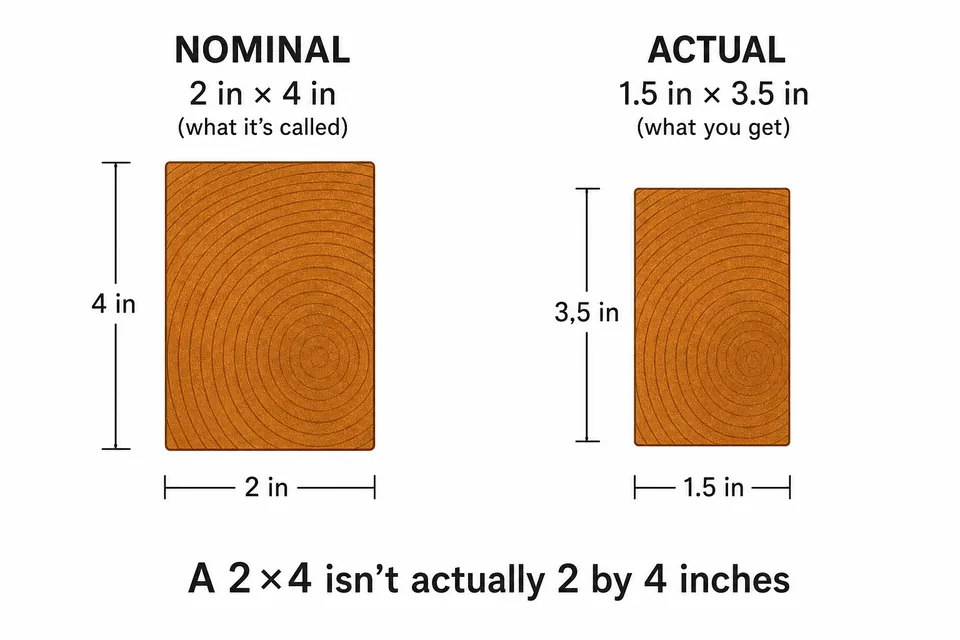
This is the single concept I wish every customer understood before they called me about a "wrong" quote. Nine times out of ten the math wasn't wrong — they'd plugged the nominal label into a formula that wanted actual inches, or the reverse. Five minutes here saves that whole argument.
Why are nominal and actual sizes different?
The nominal size is the board's dimension when it's first rough-sawn and still wet. Two things shrink it before it reaches you: kiln drying pulls moisture out and the wood contracts, and surfacing (planing all four sides smooth, "S4S") removes more material. The net loss is about ¼″ on thin members and ½″ once you pass 2 inches nominal. The name stuck around because the trade has always referred to lumber by its sawn size, and changing the labels now would confuse a century of building plans.
What is the actual size of each nominal board?
| Nominal | Actual (in) |
|---|---|
| 1×4 | 0.75 × 3.5 |
| 1×6 | 0.75 × 5.5 |
| 2×4 | 1.5 × 3.5 |
| 2×6 | 1.5 × 5.5 |
| 2×8 | 1.5 × 7.25 |
| 2×10 | 1.5 × 9.25 |
| 2×12 | 1.5 × 11.25 |
| 4×4 | 3.5 × 3.5 |
Notice widths over 6 inches lose ¾″ not ½″. That's why a 2×8 is 7.25″ not 7.5″ — a detail that quietly changes a big order. For the complete reference including 1× boards and timbers, see the lumber size chart.
How does it change your board foot math?
Here's the catch that matters: softwood is priced by nominal size even though it measures smaller. So when you calculate board feet for construction lumber, you use 2×4, not 1.5×3.5. Watch what happens if you mix that up on a single 1×6×8:
- Nominal (correct for softwood): 1 × 6 × 8 ÷ 12 = 4.0 BF
- Actual (0.75 × 5.5): 0.75 × 5.5 × 8 ÷ 12 = 2.75 BF
That's a 31% swing on one board — multiply it across a framing package and you can see why the "wrong" calculator looks broken. Using the wrong basis is the top reason a calculator disagrees with a quote; the full breakdown is in why calculators give different results.
Does nominal vs actual matter for hardwood too?
It flips. Hardwood is priced by actual surface measure, with thickness called in quarters (4/4, 5/4, 6/4). So for hardwood you measure the real width and length, while for softwood you trust the nominal label. I keep two mental modes for this, and honestly that's the only "trick" — know which market you're standing in. The thickness side of hardwood is its own topic in the hardwood thickness guide.
If you're buying framing lumber at a big-box store, think nominal. If you're at a hardwood dealer with a tally stick, think actual. The board foot calculator has a separate mode for each so you never mix them up.
Frequently asked questions
What is the actual size of a 2x4?
A nominal 2×4 actually measures 1.5″ × 3.5″. It loses about ¼″ of thickness and ½″ of width to drying and surfacing.
Do I use nominal or actual size for board feet?
Nominal for softwood construction lumber (it's priced that way), actual surface measure for hardwood. Mixing them up is the #1 cause of a board foot mismatch.
Why do boards over 6 inches lose more width?
Wider boards lose ¾″ instead of ½″ in surfacing, so a 2×8 finishes at 7.25″ and a 2×10 at 9.25″ rather than 7.5″ and 9.5″.