Reference chart
Lumber Size Chart: Nominal vs Actual
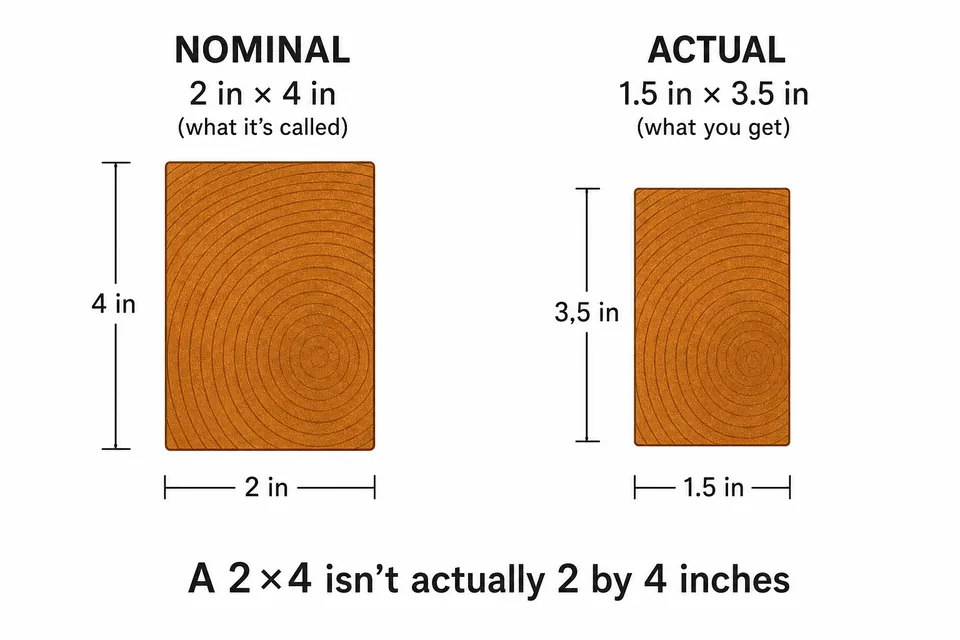
A "2x4" isn't 2 by 4. Every dimensional board is named for its rough green size, then dried and planed smaller. This chart gives the actual surfaced dimensions in inches and millimetres for the sizes you'll meet at any North American yard, and exactly how much width each one gives up.
How do I use this size chart when I'm buying?
The first thing I tell anyone new to a lumber yard is that the chart below settles arguments, not the calculator. When a builder swears his joists won't fit, nine times out of ten he measured an actual 9.25″ 2x10 and expected a clean 10 inches. So I keep this table for fit questions, and I keep board-foot math on a separate page — if you're chasing the pricing number instead, start with how to calculate board feet, because that's a different question than "how wide is this board really."
A quick story on why the gap matters. I once signed off on a deck-skirting order where the carpenter had planned his gaps around a 6-inch 1x6. The actual board is 5.5″ so across a 40-ft run he came up about 3.3 ft short of coverage (estimate) — roughly two extra boards he hadn't bought. Half an inch per board sounds like nothing until it stacks across a whole job, and that's the exact mistake this chart exists to prevent.
So my habit at the counter is blunt: I never quote a fit dimension from the nominal name. I read the actual column out loud, write it on the cut list, and let the customer plan clearances from the real number. For thickness it's even simpler — every 2x is 1.5″ every 1x is 0.75″ no exceptions in softwood. It's the width that drifts, and the chart keeps me honest on it.
What are the nominal vs actual sizes?
| Nominal | Actual (inches) | Actual (mm) | Total width lost |
|---|---|---|---|
| 1x2 | 0.75 × 1.5 | 19 × 38 | ½″ |
| 1x3 | 0.75 × 2.5 | 19 × 64 | ½″ |
| 1x4 | 0.75 × 3.5 | 19 × 89 | ½″ |
| 1x6 | 0.75 × 5.5 | 19 × 140 | ½″ |
| 1x8 | 0.75 × 7.25 | 19 × 184 | ¾″ |
| 1x10 | 0.75 × 9.25 | 19 × 235 | ¾″ |
| 1x12 | 0.75 × 11.25 | 19 × 286 | ¾″ |
| 2x2 | 1.5 × 1.5 | 38 × 38 | ½″ |
| 2x4 | 1.5 × 3.5 | 38 × 89 | ½″ |
| 2x6 | 1.5 × 5.5 | 38 × 140 | ½″ |
| 2x8 | 1.5 × 7.25 | 38 × 184 | ¾″ |
| 2x10 | 1.5 × 9.25 | 38 × 235 | ¾″ |
| 2x12 | 1.5 × 11.25 | 38 × 286 | ¾″ |
| 4x4 | 3.5 × 3.5 | 89 × 89 | ½″ each face |
| 6x6 | 5.5 × 5.5 | 140 × 140 | ½″ each face |
What is the pattern to remember?
Thickness loses ¼″ (a 2x is 1.5″). Width loses ½″ up to 6″ nominal, then ¾″ at 8″ and wider — that's why a 2x8 is 7.25″ not 7.5″.
Why are nominal and actual sizes different?
The nominal size is the board's dimension when it's first rough-sawn and still wet. Two things shrink it before it reaches you: kiln drying pulls moisture out and the wood contracts, and surfacing (planing all four sides smooth, "S4S") removes more material. The net loss is about ¼″ on thin members and ½″ once you pass 2 inches nominal. The name stuck because the trade has always referred to lumber by its sawn size, and changing the labels now would confuse a century of building plans.
Which size do I use for board feet?
Use the nominal size for softwood board-foot math, because that's how it's priced — that's what the last column of the chart gives you. Actual size matters for fit (joist depth, drawer clearances), not for the yard ticket. Watch what happens if you mix the two up on a single 1×6×8:
- Nominal (correct for softwood): 1 × 6 × 8 ÷ 12 = 4.00 BF
- Actual (0.75 × 5.5): 0.75 × 5.5 × 8 ÷ 12 = 2.75 BF
That's a 31% swing on one board — multiply it across a framing package and you can see why the "wrong" calculator looks broken. Using the wrong basis is the top reason a calculator disagrees with a quote; the rest are in why calculators give different results.
Does it flip for hardwood?
It does. Hardwood is priced by actual surface measure, with thickness called in quarters (4/4, 5/4, 6/4). So for hardwood you measure the real width and length, while for softwood you trust the nominal label. I keep two mental modes for this, and honestly that's the only "trick" — know which market you're standing in. The thickness side of hardwood is its own topic in the hardwood thickness guide. For a per-size volume shortcut rather than a fit table, grab the multipliers on the cheat sheet.
Buying framing lumber at a big-box store? Think nominal. At a hardwood dealer with a tally stick? Think actual. The board foot calculator has a separate mode for each so you never mix them up.
Frequently asked questions
What is the actual size of a 2x4?
A nominal 2×4 actually measures 1.5″ × 3.5″. It loses about ¼″ of thickness and ½″ of width to drying and surfacing.
Why do boards wider than 6 inches lose more width?
Wider boards lose ¾″ instead of ½″ in surfacing, so a 2×8 finishes at 7.25″ and a 2×10 at 9.25″ rather than 7.5″ and 9.5″.
Do I use nominal or actual size for board feet?
Nominal for softwood construction lumber, which is priced that way, and actual surface measure for hardwood. Mixing them up is the number one cause of a board foot mismatch.
Is a 1x board really 1 inch thick?
No. Every surfaced 1x softwood board is 0.75″ thick and every 2x is 1.5″, regardless of width. The width is the only dimension that varies by size.