Lumber math, explained by a buyer
How to Calculate Board Feet
Board feet = thickness (in) × width (in) × length (ft) ÷ 12. That one line answers most searches — but the reason people land here twice is that their number doesn't match the lumber yard's. Below I walk through the formula, real examples, fractions, and the rounding rules that quietly change the total. For every calculator and guide on the site in one place, browse the full board foot guide directory.
What is the board foot formula?
A board foot is 144 cubic inches of wood — a piece 12″ × 12″ × 1″. It is a measure of volume, which trips people up because lumber is sold by the board foot but cut to a length. To find how many board feet a board contains:
Board feet = T(in) × W(in) × L(ft) ÷ 12
If you measured the length in inches instead of feet, divide by 144 rather than 12. That's the whole formula. The skill is knowing which dimensions to plug in, which is where money is won or lost. If you want the derivation of why you divide by 12, I broke it down in the board foot formula explained; if you just want the definition, start with what is a board foot.
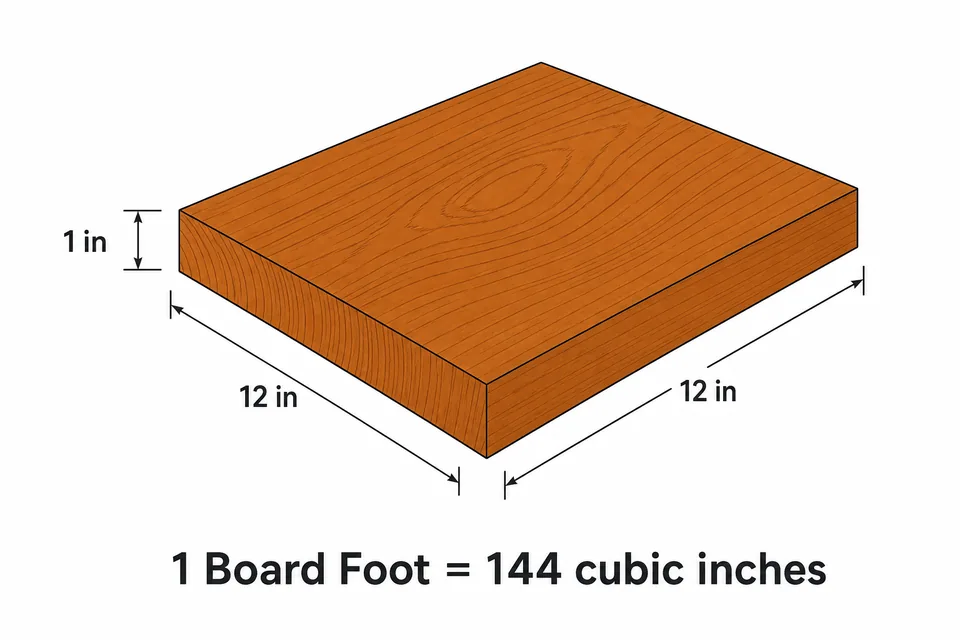
How do you calculate board feet step by step?
- Measure thickness and width in inches, length in feet. For softwood, use the nominal label (a 2×4 is "2 by 4"). For hardwood, measure the actual size.
- Multiply the three numbers.
- Divide by 12. That is the board feet in one board.
- Multiply by quantity. Add up rows for mixed sizes — a cut list calculator totals a whole project at once.
- Add a waste factor. Order 15–35% extra depending on the job — see the waste factor guide.
The math takes seconds. What takes practice is the judgment in steps 1 and 5 — which dimensions to use, and how much cushion to buy. Both are habits I've built over years of writing purchase orders, and both decide whether your number matches the yard's.
How many board feet are in common boards?
Three worked examples cover most situations you'll meet:
A single 1×6×8: 1 × 6 × 8 ÷ 12 = 4 board feet.
An 8-ft 2×4: 2 × 4 × 8 ÷ 12 = 5.33 board feet using nominal size. (See the breakdown at how many board feet in a 2×4.)
Ten 6/4 walnut boards, 6″ × 8 ft: 1.5 × 6 × 8 ÷ 12 = 6 BF each × 10 = 60 board feet. At $13/BF that's $780 in wood before waste — run it through the lumber cost calculator.
Notice the second example uses the nominal 2 × 4 even though the board is really 1.5″ × 3.5″. That is correct for softwood, and it's the difference I explain next.
How do you handle fractions and quarter sizes?
Real boards aren't whole numbers. A width of 7⅜″ is 7.375. Hardwood thickness is written in quarters: 4/4 = 1″, 5/4 = 1.25″, 6/4 = 1.5″, 8/4 = 2″ — covered fully in the thickness guide. The calculator accepts "7 3/8" and "6/4" directly so you don't have to convert in your head.
When I tally a rack of rough boards by hand, I write widths to the nearest eighth and let the decimals fall where they may — 6⅛, 7¾, 5⅜. Rounding each board's width down to a whole inch "to keep it simple" is how a 60-board order quietly loses three or four billable feet. Precision here protects you in both directions.
Nominal or actual — which size do you use?
This one choice causes more board foot arguments than anything else. Softwood (framing lumber from the home center) is sold by its nominal name. A "2×4" measures 1.5″ × 3.5″, but you calculate and pay as if it were 2 × 4. Hardwood (walnut, oak, maple from a lumber dealer) is sold by surface measure — the actual width and length of each board, with thickness called in quarters.
So a softwood 1×6×8 is 4 BF on the nominal label, while a hardwood board measured at its true 0.75″ × 5.5″ × 8 ft is only about 2.75 BF. Same stick, two answers, depending on the market it's sold in. Use nominal for construction lumber and actual surface measure for hardwood, and most "the calculator is wrong" emails I get disappear. The full chart is in nominal vs actual lumber dimensions, and the side-by-side reasons are in why calculators give different results.
How do hardwood dealers round board feet?
Hardwood is graded and tallied under National Hardwood Lumber Association (NHLA) rules, and the rounding is where buyers get surprised. Two things happen before a price is set: thickness rounds up to the next quarter, and each board's surface measure rounds to the nearest whole foot.
Here is a real tally I'd write at the counter. A 4/4 walnut board surfaces to about 13/16″, but it bills as a full 4/4 (1″). Say it's 7¼″ wide × 9 ft 4 in long. Surface measure = 7.25 × 9.33 ÷ 12 = 5.64, which NHLA rounds to 6 board feet. Multiply by the called thickness, and you're paying on 6 BF even though your tape-measure volume said 5.6. Across a 200-board pack, that half-foot-per-board rounding is real money — not a scam, just the rule. I built the hardwood board foot calculator to mirror exactly this, so your estimate lands where the invoice does.
Why is a log's board foot count different?
If you're estimating lumber yield from a standing log instead of a finished board, the plain T × W × L formula doesn't apply — a round log has no flat width, and you're predicting how many board feet of usable lumber the sawyer can pull out. That's what log rules do. The Doyle rule, Scribner, and the International ¼-inch rule each estimate yield differently, and on a small log they can disagree by 30% or more.
I've watched the same 14-inch log "lose" four board feet just by switching the buyer's rule from International to Doyle. If you're buying or selling logs, that gap is the whole negotiation — use the log board foot calculator and know which rule is on the ticket before you shake hands.
Is there a board-foot-per-foot shortcut?
Once you know a board's cross section, its board feet per linear foot never changes — so you can multiply by length in your head. The shortcut is (thickness × width) ÷ 12. A 2×6 is 12 ÷ 12 = exactly 1 BF per foot; a 2×12 is 24 ÷ 12 = 2 BF per foot. These are the numbers I keep memorized for the sizes I touch most:
| Nominal size | BF per linear foot | BF at 8 ft |
|---|---|---|
| 1×6 | 0.500 | 4.00 |
| 2×4 | 0.667 | 5.33 |
| 2×6 | 1.000 | 8.00 |
| 2×8 | 1.333 | 10.67 |
| 2×10 | 1.667 | 13.33 |
| 2×12 | 2.000 | 16.00 |
| 4×4 | 1.333 | 10.67 |
Print the full version from the board foot cheat sheet — it's the one page I'd take to the yard if I could only take one.
How do you estimate board feet for a whole project?
A single board is easy; a project is a list of different sizes, and that's where mistakes compound. The method is the same — board feet per piece, then total — but you do it row by row. Here's a small bookshelf in 4/4 walnut:
| Part | Qty | Size (in × in × ft) | BF each | BF total |
|---|---|---|---|---|
| Sides | 2 | 1 × 10 × 6 | 5.00 | 10.00 |
| Shelves | 4 | 1 × 10 × 3 | 2.50 | 10.00 |
| Back rails | 3 | 1 × 4 × 3 | 1.00 | 3.00 |
| Net total | 23.00 BF | |||
That's 23 net board feet. Add a 20% waste factor for a hardwood project with defects to cut around, and you'd buy about 28 BF. Then remember the dealer tallies each rough board with NHLA rounding, so the invoice footage will read a touch higher than your clean 28. The cut list calculator does all of this — per-row totals, waste, rounding, even estimated weight for the truck — and saves it so you can rebuild the order next time.
What mistakes inflate your board foot total?
- Mixing nominal and actual. Calculating a 2×4 as 2″ × 4″ instead of 1.5″ × 3.5″ overstates volume by ~30%.
- Forgetting hardwood rounds up. Dealers round thickness up to the next quarter and each board to a whole foot — read why calculators disagree.
- Ignoring gross vs net tally. Rough lumber is often billed at a higher gross measure — see gross vs net tally.
- No waste factor. Ordering exactly your net board feet guarantees a second trip.
- Confusing board feet with square or linear feet. They measure different things — compare BF vs SF and BF vs LF.
How do you double-check your board foot total?
Before you commit to an order, I run three quick sanity checks. First, does the unit make sense — board feet for volume, not square feet for area or linear feet for length? Mixing those up is the fastest way to a wildly wrong number, which is why I keep board feet vs square feet and board feet vs linear feet straight in my head.
Second, does my per-foot shortcut roughly match the full calculation? If a 12-ft 2×10 doesn't land near 20 BF (1.667 × 12), I've fat-fingered something. Third, is my total in the right ballpark for the project — a small bookshelf shouldn't need 200 board feet. Estimating is a skill of catching your own errors before the yard does, and these three checks catch almost all of mine.
On a 95 BF walnut order I once tallied 95.6 BF by tape; the invoice read 104 BF. The gap wasn't an error — it was quarter rounding plus a gross tally on rough stock. Knowing that, I didn't argue the total; I confirmed the basis and moved on. The single best habit is to calculate your own tally before you walk in, then check it line-by-line against the invoice. Every honest yard expects a buyer who knows their board feet — the how to buy lumber by the board foot guide is my pre-purchase checklist.
Frequently asked questions
What is the board foot formula?
Board feet = thickness (in) × width (in) × length (ft) ÷ 12. If length is in inches, divide by 144 instead.
Do I use nominal or actual size to calculate board feet?
Nominal for softwood construction lumber, actual measured size for hardwood. This is the most common reason two people get different numbers. See nominal vs actual.
How do I calculate board feet for multiple boards?
Find board feet for one board, multiply by quantity, and sum mixed sizes. The cut list calculator totals everything and rounds each board like a dealer.
How do I convert board feet to a dollar cost?
Multiply total board feet by the price per board foot. 60 BF of walnut at $13 is $780. Species and grade move the price a lot, so plug your own rate into the lumber cost calculator.
Why does the lumber yard's board foot count come out higher than mine?
Usually NHLA quarter rounding, whole-foot surface-measure rounding, or a gross tally on rough stock. It's standard practice, not overcharging — the detail is in why the yard charges more.